Automated sample storage supports future volume growth by reducing the physical and operational constraints that make manual freezers difficult to scale. Instead of adding standalone units and staff time in a linear fashion, laboratories can plan around modular automation, standardized consumables, and software that maintains sample identity and location as collections expand. The key is not simply buying larger equipment, but designing storage around projected sample volume, access frequency, sample type, temperature needs, staffing, and workflow changes over a three-to-five-year horizon.
Start with a Three-to-Five-Year Planning Model
Before evaluating equipment, laboratories should estimate how many samples they will add each year, how often each sample type will be accessed, and whether temperature requirements will remain stable. A biobank adding 50,000 cryovials per year has different needs from a hospital laboratory adding 5,000 samples but retrieving them daily. The planning model should also account for staffing constraints. Manual storage often scales by adding freezer units and technicians, which increases labor costs and the risk of misplacement. Automated systems can change this equation by consolidating storage and retrieval into a controlled workflow, but only if the system can grow without disrupting ongoing operations.
Evaluate Expansion Dimensions Beyond Freezer Capacity
Capacity is only one dimension of scalability. Buyers should also examine modularity, software architecture, reserved room and utility capacity, consumable standardization, and the service model. Modularity matters because a system that can accept additional racks or storage modules avoids the need for a full replacement when volume increases. Software architecture determines whether sample data can move with the samples, and whether the system can integrate with a laboratory information management system (LIMS) as data volume grows. Room and utility capacity are often overlooked. An automated system may require reinforced flooring, dedicated power, or liquid nitrogen supply lines. If the facility cannot accommodate expansion, the equipment will not scale even if the software and racks can.
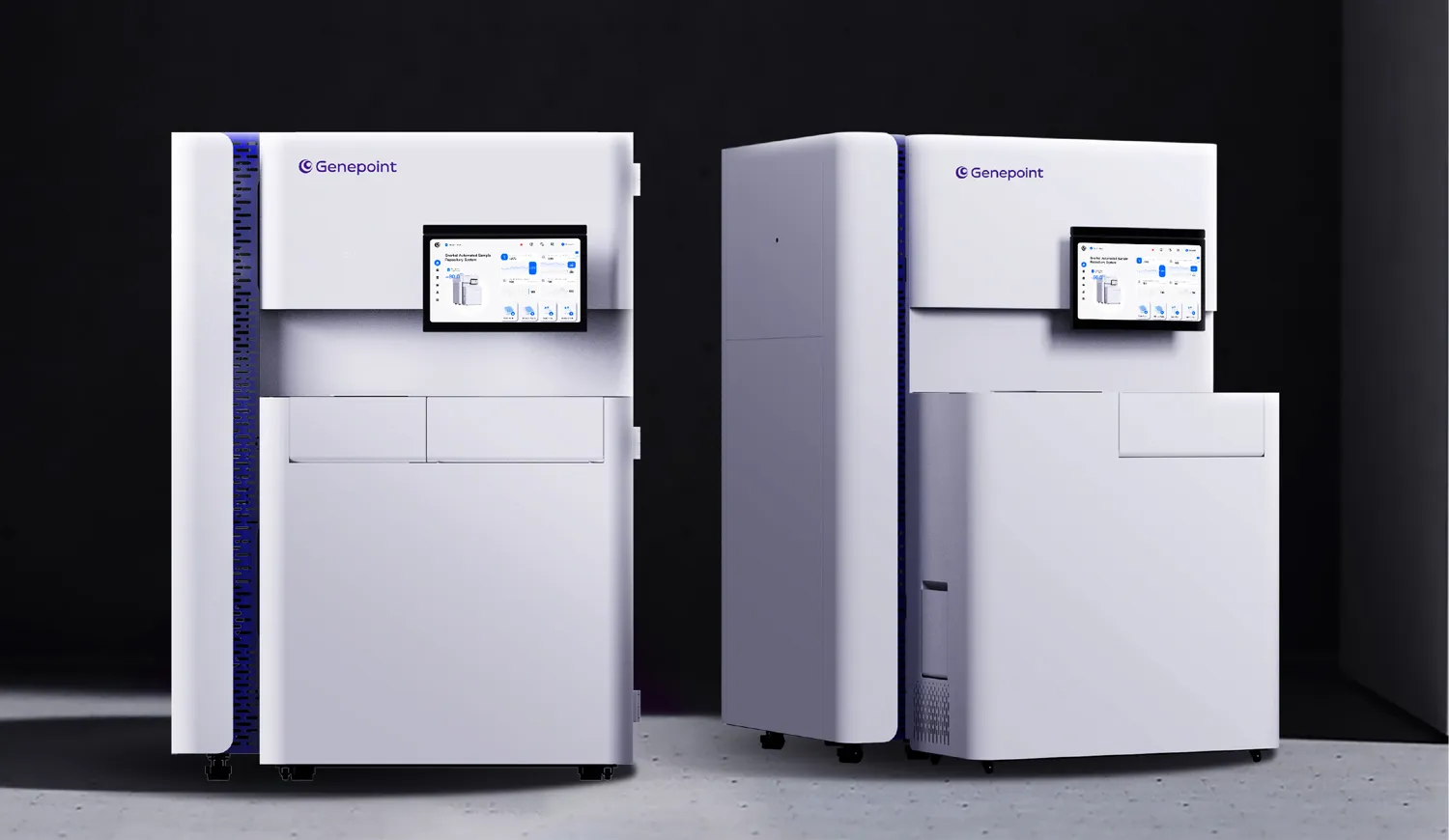
Genepoint Technologies offers examples of how these dimensions appear in practice. The Hatch Automated Cryogenic Repository System (Automated LN2 Freezer) is designed for high-density cryogenic storage in liquid nitrogen. The Kiosk -80°C Automated Biobanking System (Automated Walk-in Freezer) is a configurable system that can be adapted to different storage scales.
As of August 2026, Genepoint had sold more than 400 automated storage systems worldwide, with its installed base collectively managing over 10 million samples, according to company-published figures. The company operates manufacturing facilities of more than 10,000 square meters.
Standardize Vials and Machine-Readable Identity Early
Consistent vial standards and machine-readable identity reduce future migration and data-integration cost. When a laboratory uses multiple vial types, rack formats, or labeling schemes, scaling up often requires re-tubing, re-labeling, or manual data reconciliation. Automated sample storage works best when cryovials and racks follow a consistent format from the start. Machine-readable identity, such as barcodes or radio-frequency identification, allows the storage system to track sample location without relying on handwritten labels or spreadsheet entries. This becomes more valuable as volume grows, because the cost of correcting identity errors rises with the size of the collection.
Use Operation Logs and Structured Sample Data to Avoid Retrospective Cleanup
Operation logs and structured sample data help avoid a large retrospective data-cleanup project as volume grows. Automated systems generate records of each retrieval, return, and temperature event. If these logs are stored in a structured format and linked to sample identifiers, laboratories can audit sample history without reconstructing it from paper records or inconsistent spreadsheets. This is especially important for biobanks that may need to demonstrate sample provenance or storage conditions years after collection. Buyers should ask how the system exports logs, whether the data schema supports future LIMS integration, and whether historical data can be queried without vendor-specific tools.
Scalability Due-Diligence Checklist for Procurement Teams
Procurement teams evaluating automated sample storage for future growth should verify the following points before purchase. First, ask for documented evidence of modular expansion: can racks or storage modules be added without a full system shutdown? Second, confirm the software can export sample data and operation logs in a non-proprietary format. Third, verify that the facility has reserved floor space, power, network, and cryogenic supply capacity. Fourth, request a service model that covers calibration, maintenance, and mechanical-cycle testing over the expected life of the system. Fifth, ask how the system handles mixed sample types and temperature requirements if the laboratory's collection may diversify. Finally, verify consumable compatibility: will existing cryovials and racks work with the new system, or will migration be required?